
All Scholars
KARSTEN, Simon
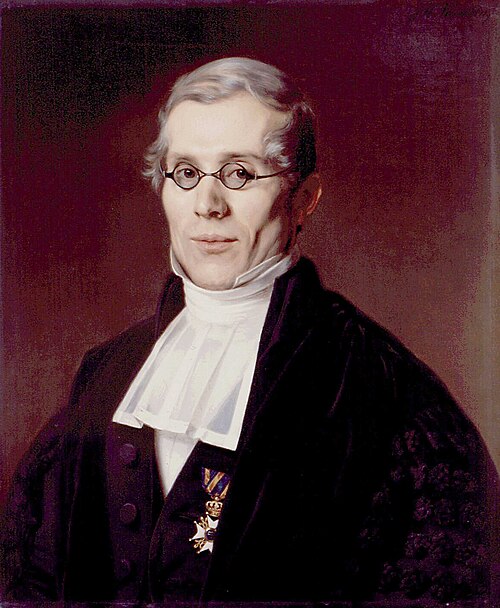
- Date of Birth: June 13, 1802
- Born City: Utrecht
- Born State/Country: The Netherlands
- Parents: Hermanus, conrector of the Hieronymus school in Utrecht, & Thresia Margaretha Corton K.
- Date of Death: May 7, 1864
- Death City: Utrecht
- Death State/Country: The Netherlands
- Married: Barbara Maria Schade van Westrum November 14, 1833, Amsterdam.
- Education:
Early education at home; Ph.D., Utrecht, 1825.
- Dissertation:
Specimen literarium quo continentur tria Pindari Carmina (Ph.D., Utrecht, 1825).
- Professional Experience:
Teacher in Utrecht, 1825-6; prof. classical literature and rhetoric, Brussels Gymnasium in Brussels, 1826-30; The Latin School, Utrecht, 1830-2; teacher, Utrecht Gymnasium, 1832-3; Rector, Latin school, Amersfoort, 1833-40; prof. literature, Utrecht, 1840-64; rector, 1846-7; member, Royal Netherlands Academy of Sciences, 1837; Society of Dutch Literature, Leiden, 1849; Knight of the Order of the Netherlands Lion.
- Publications:
Xenophanis Colophonii carminum reliquiae (Brussels: I. Frank, 1830); Philosophorum Graecorum veterum praesertim qui ante Platonem floruerunt operum reliquiae (Amsterdam: J. Müller et Soc., vol. 1: Xenophanes, 1830; vol. 2: Parmenidis Eleatae carminum reliquiae, 1835; vol. 3: Empedoclis Agrigentini carminum reliquiae, 1838; Oratio de antiquarum literarum doctrina cum philosophia conjungenda. Amsterdam: J. Müller, 1840); De tetralogia tragica et didascalia Sophoclea (Amsterdam: J. Müller, 1846); Verhandeling over palingenesie en metempsychosis (Amsterdam: J. Müller, 1846); Oratio de cautione adhibenda in veritatis indagatione (Utrecht, Kemink et fil., 1847); Introductio in historiam universalem, praecipue antiquarum gentium, scholis academicis accommodata (Utrecht: Kemink et fil., 1849); De historiae Romanae antiquissimae indole et auctoritate, deque primis Romae regibus (Utrecht: Kemink et fil., 1849); Aeschyli Agamemnon, recensuit emendavit annotationem et commentarium criticum adjecit (Utrecht: Kemink et fil., 1855); Excerpta e veteribus poetis Graecis (Utrecht: Kemink et fil., 1856); Over het epitaphium voorkomende bij Demosthenes De corona. Amsterdam: C.G. van der Post, 1858); Cicero pro Roscio Amerino (Utrecht: Kemink et fil., 1861); Quintus Horatius Flaccus: Ein Blick auf sein Leben, seine Studien und Dichtungen (trans. from the Dutch) (Leipzig & Heidelberg: Winter, 1863); Σιμπλικίου εἰς τὰ Ἀριστοτέλους περὶ οὐρανοῦ ὑπόμνημα / Simplicii commentarius in IV libros Aristotelis De caelo (with J.C.G. Boot) (Utrecht: Kemink et fil., 1865).
Full bibliography: P. H. Damsté's (see below) vol. 3, cols. 673–74 & J.I. Doedes, Rektoratsrede (Utrecht: 1865) 49-51.
- Notes:
Simon Karsten was first taught by his schoolmaster father and by the school rector of the Latin School Samuel Nijhoff (1767-1847). He matriculated at the University of Utrecht at sixteen and heard the theologian and mathematician Johannes Friedrich Ludwig Schröder (1774-1845), the philologist Antonie van Goudoever (1785-1857) and the philosopher Philipp Wilhelm van Heusde (1778-1839). He completed his doctorate at age 22 with a dissertation on Pindar, Olympians 2 & 6 and Pythian 1. He had to flee Brussels during the Belgian revolution of 1830 and return to Utrecht, where he taught Greek, ancient history, and ancient philosophy at the secondary level for 14 years before securing a professorship at Utrecht.
In the midst of manifold duties at Amersfoort he began collecting the fragments of Xenophanes (1830), Parmenides (1835) and Empedocles (1838), and arranging them into systematic modern editions with commentary, combining his skill at close textual study with his interest in intellectual history. This pioneering work gave a base to subsequent editions, particularly Hermann Diels’s Die Fragmente der Vorsokratiker (1903).
Karsten’s research shows considerable breadth. He produced work in poetry, philosophy, tragedy, oratory, and history. His work on Sophocles (De tetralogia tragica et didascalia Sophoclea, 1846) and his edition of Aeschylus' Agamemnon (1855) show the Dutch characteristics of deep philological skill at textual criticism, but neither was a breakthrough or a milestone. His membership in learned Dutch societies show the esteem in which he was held by his peers. The German translation of his study of Horace (1863) reached a wide audience. His edition of Simplicius’s commentary on Aristotle's De caelo appeared posthumously and was superseded by J.L. Heiberg's (1854-1928) 1894 edition. His career was hampered by writing mostly in Dutch or Latin and most of his editions have been superseded. Nevertheless, he was a scrupulous editor who made Greek philosophical poetry more accessible than it had previously been and he trained up generations of Utrecht students in his rigorous methods.
- Sources:
C.M. Francken, Handel d. Maatch v. Neder. Letter, (1865) 63-117P.H. Damsté, (Nieuw Nederlandsch Biografisch Woordenboek Amsterdam: N. Israel, 1974) 673-4; Abraham Jacob van der Aa, Biographisch Woordenboek (Haarlem: J.J. Brederode, 1878) 319.
- Author: Ward Briggs